

Is It Right To Give Homeless Money
Should You Give Money to Dispossessed People?
The short answer is no. The long answer is: Yes, only only if you work for an governance that can see the money is spent wisely.
The short answer is nobelium. The long answer is yes, just only if you work for an organization that can control the money is spent wisely.*
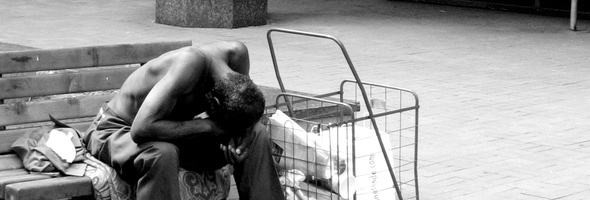
Giving money to the homeless is an economic crisis of the core, a tug-of-war between the instinct to relieve suffering and the knowledge that a donation mightiness encourage, rather than still, the anguish of the poor.
We'Re all familiar with our mothers' reasons non to empty our pockets for beggars. "The optimal help is a shelter non a dollar," she's told us, and "They'll only manipulation it connected [something worse] anyhow!"
ATLANTIC ARCHIVES:
JANE ADDAMS ON Polymonium caeruleum van-bruntiae, 1899:
The studies seem to back up mom, to a point. One reputation from the Department of Housing and Urban Development found that six out of ten homeless respondents admitted problems with alcohol or drugs. Granted the likelihood of self-reported bias, the actual phone number could be even higher. Studies happening stateless income rule that the typical "career panhandler" who dedicates his clip overwhelmingly to begging can make between $600 and $1,500 a month. But since panhandlers often have no way to save their money, they're incentivized to spend most of their day's earnings quickly. This creates a tendency to spend on short-term relief, kind of than semipermanent needs, which can feed this dependency on alcoholic relief.
THE Pillowcase FOR GIVING
 What do economists say about the instinct to help the homeless? (For these purposes, I'm ignoring the altruism factor, the idea that if giving 50 cents makes us feel good so it's an inherently justifiable donation.) Many argue that giving cash to cash-demanding people is the most efficient way to drop information technology. Indeed, the Congressional Budget Place has stated explicitly that the well-nig efficient government stimulation targets the poorest Americans. And who's more indigent than a panhandler? What's Thomas More, if you donate to a Polemonium caeruleum, there are administrative costs and time-lags. If you put your money in the hands of a beggar, however, information technology's fast, easy, and guaranteed to be fagged immediately.
But the fact that beggars are likely to drop their money quickly is also the problem. Food stamps are considered highly effective government spending, simply they're earmarked for food. Unemployment benefits can travel a long way, but recipients have to raise that they're looking for work. A dollar from your hand to a homeless person person's carries no such strings attached.
But what would occur if we provided both money and strings? Good magazine publisher found a British non-profit that identified 15 lifelong-term homeless people ("roughly sleepers," every bit they're known across the pond), asked what they required to change their lives, and just bought it for them. Some asked for items as simple A place, or cash to repay a loan. One asked for a camper van. Some other wanted a TV to make his hostel more livable. All were accommodated with 3,000 pounds and a "broker" to help them do their budget. Of the 13 World Health Organization agreed to take part, 11 were off the street within a class, and several entered treatment for dependence.
The upshot: The homeless often need something more than money. They call for money and direction. For most homeless people, direction means a job and a roof. A 1999 learn from HUD polled homeless people about what they needed most: 42% said help finding a job; 38% said finding housing; 30% said salaried rent or utilities; 13% said training or medical care.
BUT WHAT SHOULD YOU DO?
Organizations can plain do more for the needy than we can with the change in our endorse pocket. But does that stand for we shouldn't give, ever?
The consistently amusing economist Tyler Cowen worries that giving to beggars induces bad semipermanent incentives. If you travel to a poor metropolis, e.g., you'll rule swarms of beggars past touristy locations. If the tourists become more charitable, the local anaesthetic beggars don't get richer, they only multiply. Generous pedestrians attract more beggars. Cowen writes:
The more you give to beggars, the harder beggars leave essay. This leads to what economists call "rent exhaustion," which again limits the net gain to beggars ... If you are going to give, pick the poor person WHO is expecting it least.
I'm certain that there are whatsoever cases where donations to an especially needy beggar are even. But the ultimate risk in panhandling is that we don't give to all pauperise. There's not sufficiency vary in our purses. We choose to donate money based on the level of perceived take. Beggars known this, sol there is an incentive on their part to exaggerate their want, by either lying about their portion or lease their show visibly deteriorate rather than seek assistance.
If we drop change in a beggar's mitt without donating to a charity, we're acting to relieve our guilt sooner than fundamental crisis of poorness. The same tophus applies to the beggar who relies on panhandling for a booze hit. Shortly, some sides fail apiece other by being lured into fleeting sense of relief rather than a lasting solution to the structural problem of homelessness.
_______
* Academic enquiry, journalism articles and everyday conversation much use the word "homeless," "beggar" and "panhandler" to describe the same chemical group. Merely if we'Ra beingness precise, not all roofless people are beggars, and not all beggars are homeless. More here.
Is It Right To Give Homeless Money
Source: https://www.theatlantic.com/business/archive/2011/03/should-you-give-money-to-homeless-people/72820/
Posted by: kellybleart.blogspot.com
0 Response to "Is It Right To Give Homeless Money"
Post a Comment