

Which Of The Following Best Explains The Demographic Makeup Of Congress Quizlet
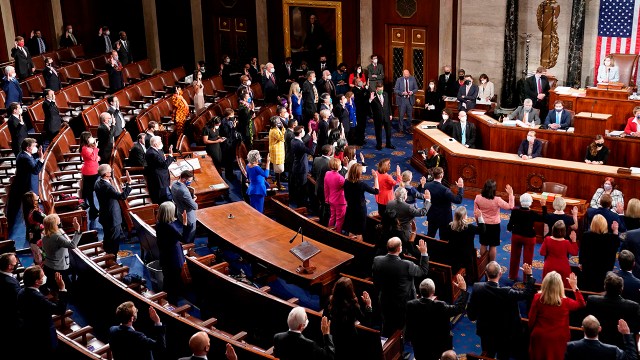
Women brand upwards but over a quarter of all members of the 117th Congress – the highest percentage in U.S. history and a considerable increase from where things stood even a decade ago.

Counting both the House of Representatives and the Senate, 144 of 539 seats – or 27% – are held by women. That represents a 50% increase from the 96 women who were serving in the 112th Congress a decade ago, though information technology remains far beneath the female share of the overall U.South. population. A record 120 women are serving in the newly elected Firm, accounting for 27% of the total. In the Senate, women concur 24 of 100 seats, ane fewer than the record number of seats they held in the terminal Congress.
This analysis counts voting also equally nonvoting members of Congress. Figures for the 117th Congress exclude two House seats that were vacant as of early January. It likewise excludes Sens. Kamala Harris, who is expected to resign her seat ahead of her inauguration every bit vice president on Jan. 20, and Kelly Loeffler, who lost a runoff election in Georgia earlier this month. Both are set up to be replaced by men.
This assay builds on before Pew Research Centre work to analyze the gender makeup of Congress.
In the House, one New York race has non been called however, and one Louisiana seat is empty considering the congressman-elect died before he could be sworn in. Both seats were vacant when Congress was sworn in on Jan. iii, 2021, so the current number of representatives is 439. This analysis includes nonvoting members.
Contained members of Congress are counted with the party they caucus with.
Because Sen. Kamala Harris will arise to the vice presidency this month, we are non including her in the count of female senators. We are, yet, counting her seat as Democrat-held because a Democrat has been named to accept her place.
For historical information on Congress, we used information from the Biographical Directory of the The states Congress, the U.Due south. House of Representatives Office of the Historian, the Congressional Enquiry Service'southward "Women in the U.s.a. Congress, 1917-2014" and CQ Whorl Telephone call. For 2020-21 ballot results, nosotros used data from Ballotpedia and the Associated Press, as well as news reports.
Women brand up a much bigger share of congressional Democrats (38%) than Republicans (fourteen%). Across both chambers, there are 106 Democratic women and 38 Republican women in the new Congress. Women account for 40% of Business firm Democrats and 32% of Senate Democrats, compared with 14% of House Republicans and sixteen% of Senate Republicans.
The 2020 full general election sent but ane new congresswoman to the Senate, Republican Cynthia Lummis of Wyoming, making her the offset female senator to represent that state.
Republican women made meaning gains in the House in the virtually recent election cycle. Of the 27 newly elected representatives who are women, two-thirds (eighteen) are Republicans. Between the 115th and 116th Congresses, the number of GOP women in the House fell from 25 to xv. That number doubled this twelvemonth to xxx, the highest full e'er.
California Rep. Nancy Pelosi, a Democrat and the offset female speaker of the Business firm, is serving her fourth term as speaker subsequently being reelected earlier this month.
The partisan gender sectionalisation hasn't always looked this way. Until the 1929 stock market place crash, most of the dozen women elected to the House were Republicans, and for several decades later the two parties were mostly close in numbers in that chamber. But the gap widened in the 1970s and has persisted, despite a temporary narrowing during the Reagan-Bush 1980s. Of the 232 women elected to the Firm in 1992 or later, 157 (68%) accept been Democrats, equally have 27 of the 42 women (64%) who take served in the Senate since 1992.
The history of women in Congress
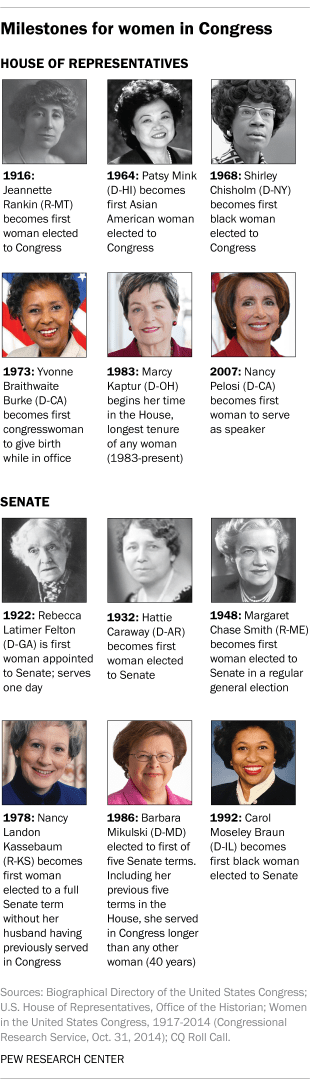
Women accept been in Congress for more a century. The first, Republican Jeannette Rankin of Montana, was elected to the House in 1916, two years after her land gave women the vote. But it's just been in the past few decades that women have served in more substantial numbers. About two-thirds of the women ever elected to the House (232 of 352, including the newest members of the 117th Congress) have been elected in 1992 or afterwards.
The pattern is like in the Senate: 42 of the 58 women who have always served in the Senate – including Lummis, the newest female person senator – took office in 1992 or afterwards.
The 19th Amendment, which extended the franchise to women across the nation, was ratified in 1920. That Nov, Alice Mary Robertson of Oklahoma became the first woman to defeat an incumbent congressman. (She lost the seat back to him two years later.) In 1922, veteran suffragist Rebecca Latimer Felton of Georgia was appointed to fill a vacant Senate seat; when Congress was unexpectedly called back into session, Felton was sworn in as the first-ever female senator, though she only served for a day.
While women remained scarce in the Senate well into the 1980s, their numbers gradually, though not consistently, increased in the House – generally paralleling the expansion of women's roles in lodge more than broadly. In 1928, vii women were elected to the 71st Congress, a record at the time, and two more joined them later via special election. But that trend plateaued during the Great Depression and World War Two. It wasn't until after the war that the upward trajectory of women in Congress resumed, with eighteen women serving in the House in 1961-62.
Although the 1970s saw prominent figures such as Barbara Jordan, Elizabeth Holtzman and Bella Abzug enter Congress, women's overall numbers didn't change much until 1981, when their Business firm caucus exceeded xx members for the first time. The large spring, however, came in 1992 – later dubbed "The Year of the Woman" – when four new female senators and 24 new congresswomen were elected. Academics accept offered various explanations for why 1992 was such a quantum twelvemonth for women in Congress, including an unusually large number of open seats due to redistricting and backlash from the Clarence Thomas-Anita Loma hearings.
'Widow's succession' in Congress
Well into the 1970s, i of the most common ways for a woman to enter Congress was by succeeding her deceased married man or father, either past ballot or appointment. Of the 90 women who served in the Firm between 1916 and 1980, 31 were initially elected to their married man'due south seat after he died; three were called to replace their husbands on the ballot when the men died before Ballot Day; and one, Winnifred Mason Huck of Illinois, was elected in 1922 to make full the last four months of her late father'south term. (Another early congresswoman, Katherine Gudger Langley of Kentucky, won her hubby's seat in 1926 after he resigned following his conviction for violating Prohibition laws.)
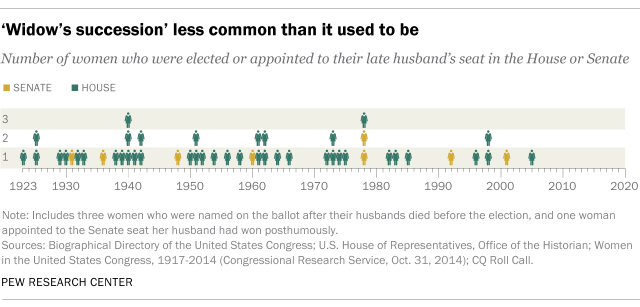
Like Langley, most of the holders of these so-chosen "widow's succession" seats stayed in Congress for only a term or two. But some went on to distinguished careers on Capitol Loma. Margaret Chase Smith of Maine, for example, won a special election in 1940 to make full the last seven months of her married man's term. Smith went on to win iv full House terms on her own, then was elected to four terms in the Senate, thereby becoming the first woman to serve in both chambers. Lindy Boggs, who was elected to her husband'south seat in 1973 after he was presumed killed in a airplane crash, served most eighteen years. She later was named U.S. administrator to the Holy Encounter.
Six of the xiv women who served in the Senate before 1980 were either elected or appointed to make full their late husbands' seats. Of those, only two (Hattie Caraway of Arkansas and Maurine Brown Neuberger of Oregon) subsequently won full terms in their own right.
Note: This is an update of a post originally published Dec. 18, 2018.
Source: https://www.pewresearch.org/fact-tank/2021/01/15/a-record-number-of-women-are-serving-in-the-117th-congress/
Posted by: kellybleart.blogspot.com
0 Response to "Which Of The Following Best Explains The Demographic Makeup Of Congress Quizlet"
Post a Comment